|
|
Periphery: Ionian Islands
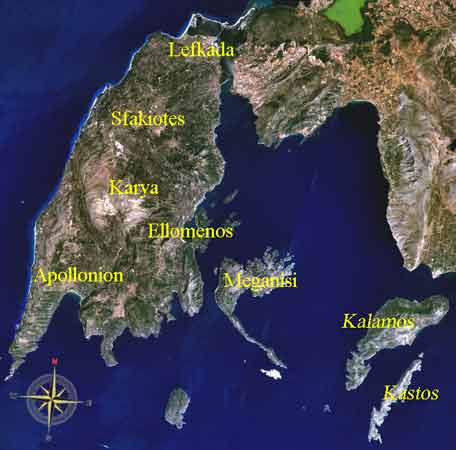
Lefkada Satellite image Lefkada Google Earth High Resolution
Lefkada, or Lefkas (Greek: Modern: Λευκάδα, Ancient/Katharevousa: -as) is a Greek island in the Ionian Sea, connected to the mainland by a long causeway and floating bridge. The capital, Lefkada, is at the north of the island, and only 20 minutes away from Preveza Airport. Lefkada, or Lefkas Town (population: 7548 in 2001), has a pedestrianised main street, marina, and bus routes to Athens. The east coast of the island has small resorts of Lefkada, Nikiana and Perigiali, all north of the largest resort on the island - Nidri. It is set in a sheltered location with views across to Skorpios - owned by Aristotle Onassis, Meganissi and other small islands, as well as the Greek mainland. The main coastal road from Lefkada to Vasiliki runs through the town, although a bypass is being built. There are regular car ferriess to Kefalonia, Ithaca and Meganisi. 20km South of Nidri is the resort of Vasiliki - a windsurfing center. There are ferries here to Kefalonia and Ithaca. South of Vasiliki is Cape Lefkatas, where Sappho allegedly leapt to her death from the 100 foot (30m) high cliffs. There are spectacular views across to Ithaca and Kefalonia, however the 16km (10 mile) unpaved road is enough to put off all but the most determined. The West coast, facing the great expanse of the Mediterranean, has the hyped beach of Porto Katsiki. To the North, there are numerous beaches, with pale golden sand and powerful waves - a sharp contrast to the more popular East Coast. It was originally united to the mainland at its northeastern extremity by a narrow isthmus. Homer speaks of it as a peninsula, and mentions its well-fortified town Nericus. It was at that time inhabited by the Teleboans and Leleges. Subsequently the Corinthians under Cypselus, between 655 and 625 BC, founded a new town called Leucas. They also cut a canal through the isthmus, and thus converted the peninsula into an island. This canal was afterwards filled up by deposits of sand, but was opened again by the Romans. During the war between Philip and the Romans, Leucas was the place where the meetings of the Acarnanian League were held. The other towns of the island were Hellomenum and Phara. Murrays Handbook of Travels 1854 The Leucadians had three ships in the battle of Salamis (Herod., viii. 45) ; and afterwards sided, like the majority of the Dorian states, with Sparta during the Peloponnesian war. In the contest between the Romans and Philip of Macedon, the Acarnanians, of whom Leucas had become the capital and national centre ( Livy, xxxiii. 17), rejected the Roman alliance, and were reduced after a gallant defence, picturesquely described by Livy. Leucas thus fell under the power of Rome, but continued to be still a place of considerable importance, as appears both from the great number of Roman coins found in the island, and also from the fact of its having been made very early the seat of a Christian Bishopric. The Bishop of Leucas was one of the fathers of the Council of Nice in A.D. 325. On the conquest of the Byzantine Empire by the Franks in the 13th century, this island fell to the lot of a Latin noble, whose family seems to have retained possession of it, with some interruptions, until it was seized by the Turks in 1467. From that time forth until the fall of the Republic of St. Mark, Leucadia was sometimes held by the Porte, sometimes by the Venetians, to which latter power it was not finally ceded till the Treaty of Passarowitz in 1718. .. After passing through, subsequent to 1797, a series of vicissitudes similar to those undergone by its neighbours, this island was occupied in the spring of 1810 by a detachment of the English forces, which in the preceding autumn had expelled the French from Cephalonia, Zante, Ithaca, and Cerigo. The Fort, garrisoned by several hundred French troops, held out for some weeks. General (then Major) Church, afterwards so well known from the command he held during the Greek War of Independence, was severely wounded in the assault which led to its capture. At the southern extremity of the island, opposite Kefalonia, was the celebrated promontory, variously called Leucas, Leucatas, Leucates, or Leucate, on which was a temple of Apollo Leucadius. At the annual festival of the god it was the custom to cast down a criminal from this promontory into the sea; birds were attached to him in order to break his fall; and if he reached the sea uninjured, boats were ready to pick him up. This appears to have been an expiatory rite; and it gave rise to the well-known story that lovers leaped from this rock in order to seek relief from the pangs of love. Thus Sappho is said to have leaped down from this rock when in love with Phaon.
Lefkada Fortress, copyright ©. Photo : Harry Gouvas http://prevezamuseum.spaces.live.com
Pantokrator Church, with the grave of the poet Aristotelis Valaoritis
Lefkada from North [Source] Climate Its climate for much of the island has hot summers and cool winters expecially in the mountains. Transportation Greece Interstate 42
Corinthos and Leucas (Lefkada) (a Corinthian colony) Division of the municipality of Lefkada
Notable persons
Google Earth Cycle Tour Lefkada Links
![]() |
|
||||||||||||||||||||||||||||||||||||||||||||