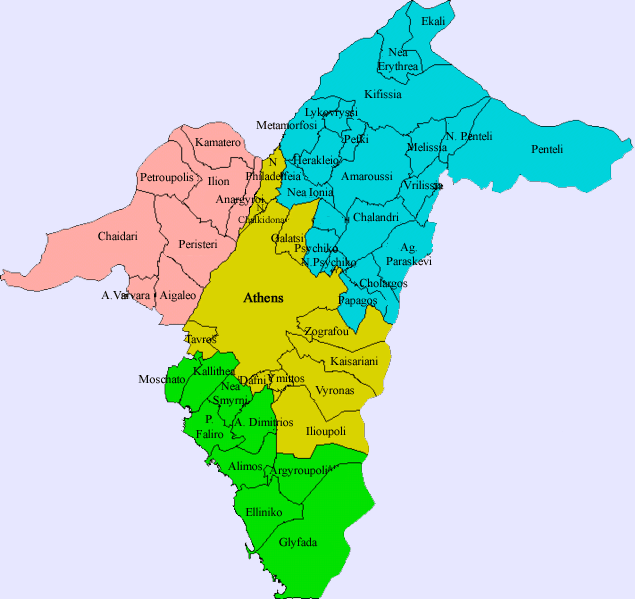
Kamatero

Periphery : Attica
Prefecture : Athens

Kamatero, (Greek, official: Καματερόν (Katharevousa); common: Καματερó (Demotic), (officially Kamateron), is a suburb northwest of Athens, Greece. It is located about 10 kilometres northwest of Athens and north of Piraeus.

History

Before 1827

Although there are no known archaeological finds in Kamatero, the area around it is known to have been inhabited since the Bronze Age, as a Mycenaean tomb has been found in the neighbouring municipality of Acharnai. In classical times, the area of modern Kamatero was under the authority of the polis of Athens. Kamatero is one of two alternative locations suggested for the location of the ancient Athenian deme of Cholargos (the other being Peristeri to the south). If ancient Cholargos was indeed in Kamatero, this would make the ancient statesman, orator and general Pericles one of the earliest and greatest natives of the area.

There are no medieval references to Kamatero as separate from the rest of the Athens area, and it can be assumed that the area followed the fate of the rest of Athens. It should be noted, however, that the prominent Byzantine Epiphanios Kamateros has been suggested as the origin of the settlement's name. While there is still a Kamateros family in Kamatero today, there is no evidence to suggest their connection to Epiphanios Kamateros. Furthermore, kamatero (Greek for "hard-working") was a word commonly used to refer to oxen. Thus, the name Kamatero could simply be a reference to the agricultural economy which was then prevalent in the settlement.


Statistics
Prefecture: Attica
Metropolitan Area: Athens
Location:
Latitude:
Longitude:

38.067 (38°3'43') N
23.704 (23°42'14') E
Area: 6 km²
Population: (2001)
22234
Elevation:
 -lowest:
 -centre:

about 140 m
160 m(centre)
Aegaleus, c. 600 / 700 m
Postal code: 134
Area/distance code: 11-30-210 (030-210)
-230 through 239
Municipal code: 0123
Car designation: Y (prev.)
Z pres.
3-letter abbreviation: KMT Kamatero
Address of administration: 54 Fylis Ave.
Kamatero 134 51

After 1827

The first known reference to the settlement, using the name Kamatero, is from the Memoirs of General Makrygiannis, written in the 19th century. The settlement is mentioned in connection to the Battle of Kamatero, during the Greek War of Independence. The battle ended in a Turkish victory, largely due to a poor choice of terain by one of the Greek commanders, Vasos Mavrovouniotis. It was also the first and only engagement in the war of Colonel Denis Bourbaki, who was beheaded by the Turks after the engagement. The outcome of the battle had considerable impact on the course of the siege of the Acropolis then ongoing by the Turks.

By the early 20th century the population of the settlement was largely made up of Arvaniots, Albanian-speaking populations with a Greek ethnic identification. Arvaniot presence used to be predominant in Ottoman-age Athens, and it is possible that the first modern settlement was founded by them, especially since the neighbouring towns of Ano Liossia and Nea Liossia (Ilion) were named after an Arvaniot landholder.

Up to the mid-20th century, the area was made up of farmlands and some forests dominated its northern part. After that point, urban development replaced much of the farmlands. Today, about two-thirds of the land are residential areas. Empty space today can be found in the western part, on the Poikilo range, which consists of rocks and pines. The last patches of forests can also be found here, as well as in the southeastern part of the municipality, in the Pyrgos Vassilissis (Queen's Tower) park area.

Government and Politics

Demographics

The area is mainly made up of urban areas to the west and east (residential areas account for about two-thirds of the municipality). Kamatero is divided in five districts: the Centre, Attalos, Aghios Trifonas, Gerovouno and Kato Tatoi. Except for the centre, all the other districts have strict construction regulations and most houses are up to two floors. The Pyrgos Vassilissis park, one of the largest in Greece, lies to the southeast, on the border with Ilio and Agioi Anargyroi municipalities.

Historical population

Year Municipal population
1981 15593
1991 17410
2001 22234

Kamatero is largely a residential area, but the populace has a distinct working and lower-middle class character. The residential development is considerable, but this is not met by a matching development of local enterprise.

Economy

Aside from small family businesses, Kamatero houses four banks, a sports centre, a post office and a few small factories. One of these was destroyed in a major fire on 10 October, 2003. However, there is a considerable growth of small-scale businesses, such as stores and restaurants, mostly focused around the town squares (plateies)

Culture

Education

Kamatero has 8 elementary schools, 3 lower-level secondary schools, and 2 upper-level secondary schools (high schools), as well as a technical school. Most high school graduates enroll in the universities and technical colleges of Athens or other Greek cities.


Kamatero, Satellite image

Links

Municipalities of Athens

Agia Varvara | Agia Paraskevi | Agioi Anargyroi | Agios Dimitrios | Athens | Aigaleo | Alimos | Amarousi | Argyroupoli | Chaidari | Chalandri | Cholargos | Dafni | Ellinikon | Filothei | Galatsi | Glyfada | Heraklio | Ilio | Ilioupoli | Kaisariani | Kallithea | Kamatero | Kifissia | Lykovryssi | Melissia | Metamorfosi | Nea Chalkidona | Nea Erythraia | Nea Ionia | Nea Filadelfeia | Nea Smyrni | Neo Psychiko | Palaio Faliro | Papagou | Pefki | Peristeri | Petroupoli | Psychiko | Tavros | Vrilissia | Vyrona | Ymittos | Zografou

(Non-municipal) Communities of Athens prefectural department

Ekali | Nea Penteli | Penteli

Municipalities of East Attica

Acharnai | Agios Stefanos | Artemida | Avlona | Gerakas | Glyka Nera | Kalyvia Thorikou | Keratea | Kropia | Lavreotiki | Marathon | Markopoulo Mesogeias | Nea Makri | Paiania | Pallini | Rafina | Spata | Vari | Vouliagmeni | Voula

(Non-municipal)Communities of East Attica

Afidnes | Agios Konstantinos | Anavyssos | Anoixi | Anthousa | Dionysos | Drosia | Grammatiko | Kalamos | Kapandriti | Kouvaras | Kryoneri | Malakasa | Markopoulo Oropou | Nea Palatia | Oropos | Palaia Fokaia | Pikermi | Polydendri | Rodopoli | Saronida | Skala Oropou | Stamata | Sykamino | Thrakomakedones | Varnava

Municipalities of the Piraeus prefectural department

Aegina | Agios Ioannis Rentis | Ampelakia Salaminas | Hydra | Korydallos | Kythira | Drapetsona | Methana | Nikaia | Perama | Piraeus | Poros | Salamina | Spetses | Troizina

(Non-municipal) Communities of the Piraeus prefectural department

Angistri | Antikythira

Provinces of the Piraeus prefectural department

Aigina | Kythira

Municipalities of West Attica

Ano Liosia | Aspropyrgos | Eleusis | Erythres | Fyli | Mandra | Megara | Nea Peramos | Vilia | Zefyri

(Non-Municipal) Communities of West Attica

Magoula | Oinoi

Retrieved from "http://en.wikipedia.org/"
All text is available under the terms of the GNU Free Documentation License

A - B - C - D - E - F - G - H - I - J - K - L - M

N - O - P - Q - R - S - T - U - V - W - X - Y - Z

Γεωγραφία της Ελλάδας

Ancient Greece

Medieval Greece / Byzantine Empire

Modern Greece

Science, Technology , Medicine , Warfare
, Biographies , Life , Cities/Places/Maps , Arts , Literature , Philosophy ,Olympics, Mythology , History , Images

Science, Technology, Arts
, Warfare , Literature, Biographies
Icons, History

Cities, Islands, Regions, Fauna/Flora ,
Biographies , History , Warfare
Science/Technology, Literature, Music , Arts , Film/Actors , Sport , Fashion

Cyprus

Greek-Library - Scientific Web